
Semantic Repetition
How being satiated by words translates to sensory overload


Do we perceive the shades in your surroundings?…
In how many instances have we felt underwhelmed by words to the point our circuits were flooded, eroding meaning. The amber in ale and the glint off a spoon become irrelevant among repetition.
Semantic repetition shows up as deliberate neural austerity where overload triggers satiation, swallowing the verbal into the void. Sartre might interject the existential sting as we are condemned to language’s freedom, yet in semantic glut, that freedom turns into self deception. Life, in its unsparing mirror, reflects this with immediacy.
At the neural level, waves of overstimulation cascade across semantic processing regions in the temporal lobe, returning us the phonetic emptiness and associative blackout reported in repetition experiments. This verbal excess illustrates how noise invades consciousness, the subject feels simultaneously diminished by the loss of meaning and enlarged by the drive to articulate it. The boundary between inner lexicon and outer world fades, as the environment saturates with indistinct forms. The work renders verbal fatigue visible, contesting the privilege of quantifiable data over experiential testimony.
Semantic repetition often extends beyond the mind into spatial and visual forms. Sol LeWitt’s wall drawings evoke a sublime effect through the overwhelming tide of repetition, where geometric patterns trade sharp perception for numbness. These vast modular grids consist of lines, squares, and cubes recombined according to strict instructions across gallery walls.
Each unit acts as a clone, generating endless permutations from a single premise. Viewers enter this field attracted by its rational order, the eye follows one sequence of open and closed forms, then another. The logic remains clear yet infinite. Individual shapes eventually dissolve into emotional blankness. This embodies semantic repetition in space. Units multiply past containment. Their initial clarity breaks into a haze and proprioception weakens. The body senses numb within flow and the cortex is tired of tracking sameness within variation.
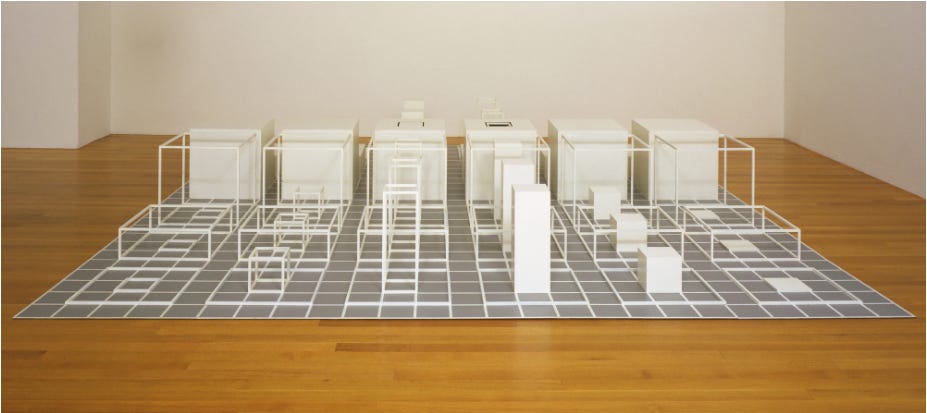
LeWitt’s approach seems to reject subjectivity. Predetermined rules are executed without taste or chance. The result offers raw information, creating overload. The viewer’s reason stretches to map the endless grid. It meets its limits. While shades retreat into perceptual fog, our inner awareness still grasps the structure’s clarity and this forces confrontation with vulnerability.
Yue Minjun’s The Luncheon on the Grass (1995) extends this into flesh and emotion. Under the light of a desk lamp, with light flowing unevenly across the desk, Yu Minjun’s The Luncheon on the Grass draws you into a picnic that’s both an invitation and a trap. The painting presents four cloned self portraits. Pink faced figures sprawl across grass, one appears nude, three clothed. Their mouths stretch in identical hysterical laughter. This setup parodies Manet’s famous picnic, yet the cloned grins create an immensity of expression beyond control.
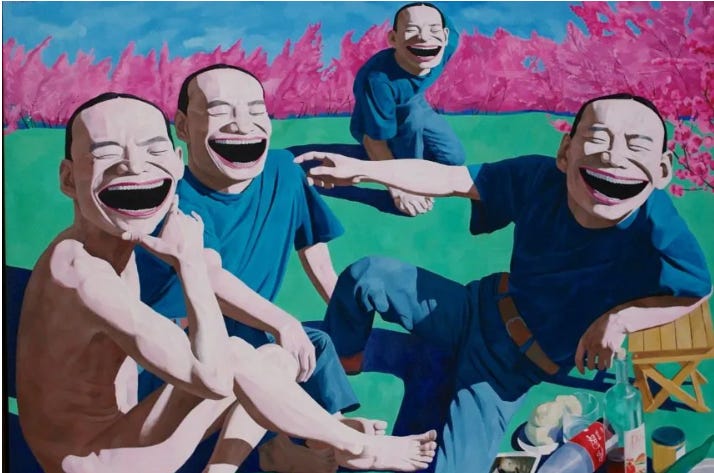
Semantic repetition takes visual form here as faces multiply past containment and background details soften despite the mind’s search for variation. The artist repeats his own image as a fixed unit, delivering raw hysteria. Here reason extends to trace the grins’ uniformity and hits limits, almost forgetting the differences among the subjects due to the prevalence of their unstable state. Figure ground distinction weakens as faces proliferate. In this case, inner awareness holds the scene’s absurdity. The laughing field resists full grasp. and it does so through emotional excess. Viewers confront fragility. Cognition shows its range.
Andy Warhol understood this before neuroscientists caught up. His Marilyn Diptych (1962) lines up fifty silkscreened portraits of Marilyn Monroe, half vivid, half fading into grey, and dares you to keep caring. You do, briefly. Then you don’t. The icon dissolves into pattern. What remains is not grief or glamour but something closer to static. Warhol called it boredom, but he meant it clinically: repetition as an instrument of erase, fame as a mechanism of its own undoing. The face that once meant something now means the fact of its own multiplication. Excess here is not decorative. It is the argument.
This is precisely where semantic repetition turns political. To flood a form with itself is to expose how fragile the meaning it once carried always was. When a word loses coherence through repetition, it does not collapse into nothing. It collapses into its material. Sound without sense. Pigment without persona. The scaffolding shows, and what it reveals is that meaning was never intrinsic. It was sustained by a collective agreement to keep looking freshly, to keep arriving at the thing as if for the first time. Repetition breaks that agreement and forces the question of what remains when recognition withdraws. What remains, apparently, is the body. When the cortex stops tracking, sensation persists. The tingling unease inside LeWitt’s grid, the low-grade discomfort of Minjun’s laughing field…these are not failures of comprehension. They are comprehension by other means. The body registers what language can no longer hold. Semantic saturation is not purely loss then. It is a redistribution. Meaning migrates from the lexical to the somatic, from the named to the felt. We are returned, briefly, to a pre-verbal attentiveness: the amber in ale, the flint off a spoon.
All before the next word arrives to name it and ignite the cycle again.
until next time
— Maria Sole & Amirali